Technique explained – Sandblasting a Yamadori Yew Bonsai

I sandblasted my first deadwood way back in 1992 and I guess I have blasted over 50 trees since then, I have perfected the technique of protecting the live veins, foliage and soil so that the aggressive nature of this technique does not upset the wellbeing of the tree.

As will any intervention on a bonsai the tree MUST be in great health. Never work on a tree that is recently collected yamadori or is not in the best health. This tree has grown well over the last three years and the deadwood was desperate to be worked. If I had waited another year the foliage would have restricted the access to in inner part of the tree, this is where the most interesting areas of deadwood are on view.

A few days before I removed an upright trunk and disguised by carving and stripping the cut, this can be seen in the photos as a bright orange area.

The process:

  • Gather the foliage up and bind with fine wire so that you have access to the live vein.
  • Using air-dried modelling clay cover the live veins right to the edge and at least 4mm thick, When dry (about 3 days) cover with Duck tape.
  • Completely cover over the soil and as close to the base of the trunk as possible, I use rubber inner tubes first then bind with commercial cling wrap.
  • Wrap the foliage in an old towel and then cover with a thick plastic bag.

The Blasting:

  • I use a commercial blasting service, you can find these locally via the internet.

The results are simply amazing, the deadwood is clean the splinters are removed from the branches I have snapped and all the detail is revealed. I do not put Lime Sulphur on immediately, as I like the wood to weather slightly prior to application.

First Look: Han Kengai Yew Project

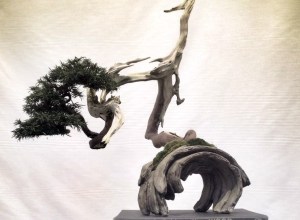
Original Han Kengai YewI collected this Yamadori Yew in 2011, the tree was very slow to establish in the first couple of years, this is due to the cambium layer being very thin because the hard growing conditions that the tree suffered. In the third year the tree thrives and this year the growth has been very strong. With very old trees such as this it’s important that you wait for the growth of the foliage to be robust and vigorous for the future development of the tree, start work too early and you could set back development or worse kill the tree!

The work undertaken this week was to remove the thick upright deadwood branches, clear the smaller dead branches near the base of the tree and reposition the whole into the ‘final’ planting position. The tree will be left for a couple of years to extend and fill out the foliage mass. I will then work on the deadwood and finally sand blast to clean and smooth out some of the rough areas. Then the first styling will take place, another year in the box and finally planting into a training pot. The foliage mass will take at least 10 years to achieve the virtual image… but I can wait if the end result will look something like this.Possible 2020

The Calligrapher, The Books and the reasoning

calligrapher at NoelandersIn 2008 Sandro Segneri one of the invited artists at this years Noelanders Trophy was in my garden. Sandor was working at the Burrs workshop and was taking time out.

When he saw this Yew Sandro was drawn to the sweeping curves of the deadwood and likened the movement of the tree to calligraphy. I find it pretentious in naming your own trees, however I liked the name Sandro gave to this bonsai.

Finding the correct pot for this tree has not been an easy task, the tree has been potted in a number of different containers. Last year Erik Križovenský from Slovakia attended one of my workshops. He brought this unusual pot for me, it was not made especially but when I saw it I considered it to be an interesting match with this tree.

The Space available to pot the root ball is quite small, planted 18 months prior to the Noelanders trophy this tree would need to be transferred to a larger pot soon after the event.

In deciding how the tree would be presented I needed to consider the strange pot, the unusual style of the tree and its name. Terry Foster and I worked with a number of different tables and none really suited the tree. We decided to look for inspiration in the many bonsai exhibition books that I have. As we waded through the pile of books nothing presented itself as a suitable option. It was then that we noticed that pile of books and wondered if these in fact could be our table.

The original idea was to wrap the books with white covers, this would make the publications anonymous however it simply did not work. In deciding to use the books ‘as is’ made my job easier and the choice of books is key to the idea. If you look carefully at the spine of each book they all form the background to the styling of the tree.

Once this decision was made the choice of accompanying planting or supporting objects needed to be considered. An accent plant or something else, the choice of Calligraphic brushes and ink stone seemed the obvious choice.

On presenting the tree for photography at the event I was very happy with the selection of books and the colours of the binding.

The tree or should I say the display was received well with most liking what I present and making a point of telling me… and a few really not getting it!

close up of the the tree

I ventured opinions from those I valued, Peter Warren was candid stating “the focus is on the books and not the tree, even though the tree is good” and I admit on reflection he is right! Everyone talked about the books… and no mention of the tree.

When considering an unusual display the quality of the tree must be excellent and not play second fiddle and I fear this may have happened. However I was surprised that the display did not look out of place, and was somewhat disappointed that more folk did not rage against it. My old friend Bill Bailey did not mince his words “I don’t like it… but I AM a traditionalist” I also overheard this comment “if I wanted to see books I would have gone to a library” I take comfort in the words of Oscar Wilde “There is only one thing in life worse than being talked about, and that is not being talked about.”  And nobody talked about the ‘other’ tree I had in the show so I guess there IS merit in what I did.

Tom Benda Bonsai Potter and The Kifu Taxus Baccatta

Toms trade stand

Toms trade stand

I have seen the work of Tom Benda develop over the last few years however his most recent work is up there with the best bonsai potters in Europe. At the recent EDA UCHI KAI exhibition in Belgium Tom’s Trade stand was the busiest by far.My Yamadori trade stand backed onto Tom’s and we had a great weekend together. It was a classic case of “buy the pot NOW” because if you don’t somebody else would! So many pots were purchased in the first few hours of the weekend.

As he would have nothing to display the scope of his work, Tom requested that the buyers collect their purchases at the end of the show. Mario Komsta and Mark & Ritta Cooper snapped up dozens of pots between them, so often through the weekend I heard “Sorry that’s been bought by Mario”… “Mark and Ritta’s” “yes… that’s Marios too!” “no… sorry Tony Tickle has bought that”

This brings me to one of the Pots that I purchased, considered by Tom as “The best bonsai pot I have ever made” (what sales technique!) This was to be for a Kifu size Yamadori Taxus Baccata that I have been working for quite a few years. The current pot is by Milan Klika, lovely but not quite right for the tree, I will be potting the tree into the new container in April 2014. To ensure that the pot will indeed suit the tree I always produce a ‘virtual’ image.

NOTE: I am now the distributor for Toms pots and will be selling them on my stand at next years Noelanders trophy, so if you DO want to purchase one of Toms amazing Pots I suggest that you get there early

The Virtual Image

The Virtual Image