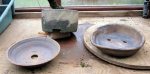
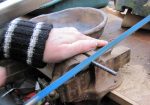
How to secure a Tall literati tree in a shallow pot.

This is an article I first posted on IBC in 2010, worth a look. The tree is no longer in my personal collection.

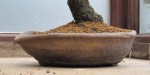
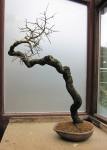
This is a Prunus Spinosa that I collected on my 50th Birthday… it’s called ‘Fifty’ and it has been in this pot for 2 years. This Beautiful Duffett pot was fine to ‘bring on’ the tree but not a good choice as it is way to ‘chunky’.

How the tree looks today

Prunus cascade repotting and change of angle

Prunus cascade

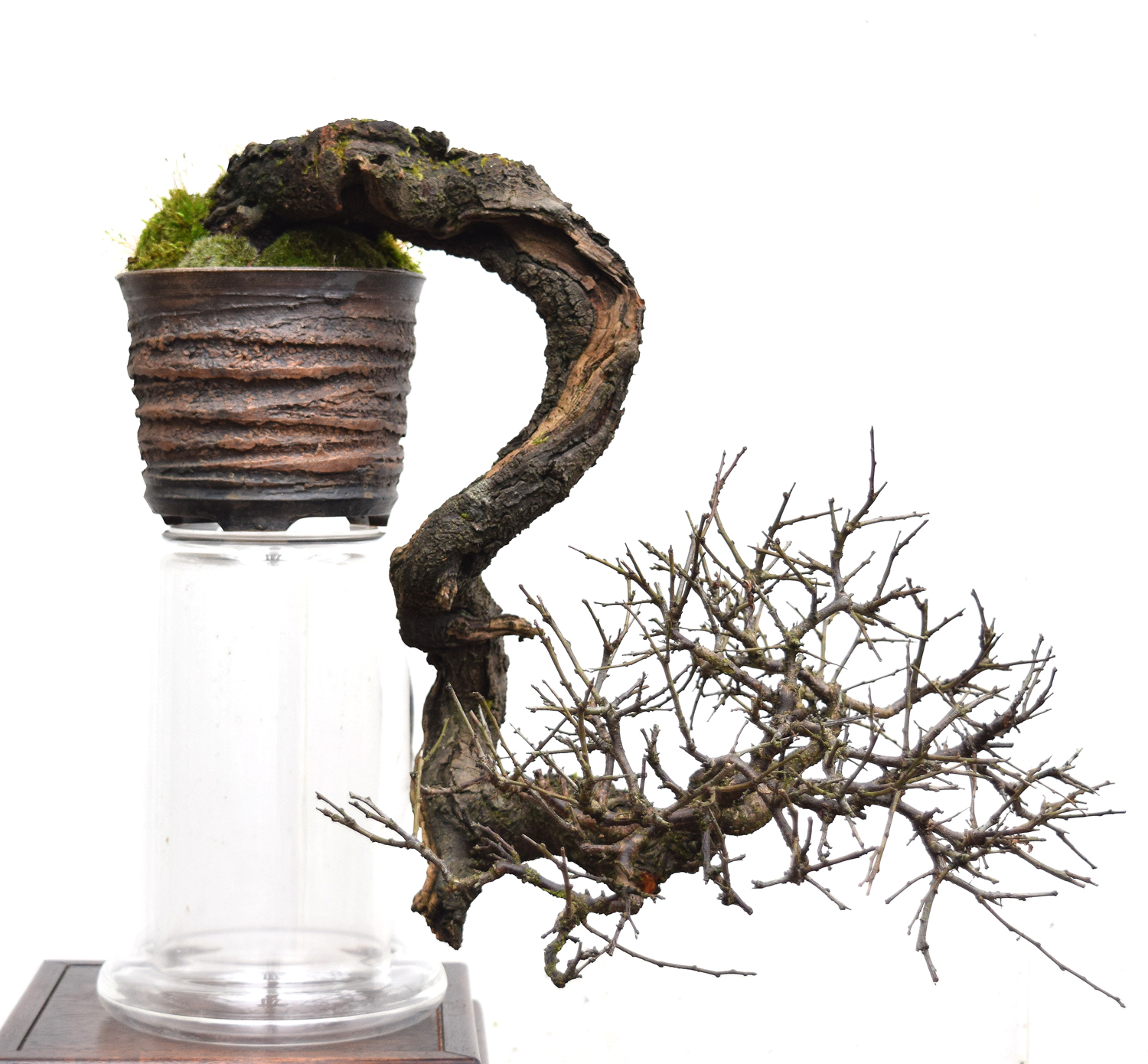
Cascade Blackthorn on the wireOccasionally the banner at the top of this blog shows this cascade Prunus Spinosa in full leaf on a Barbed Wire stand. When it was exhibited at The Noelanders show on 2012 it cause a wee bit of a stir. That photo is as the tree looked two years ago. A year later I transferred the tree into a larger pot to let the roots run free and build more vigour yet the opposite happened, I slowly lost vigour in the bottom branch. Another year in the pot to see if it would pull back, it did not, the top went from strength to strength… So here is the tree repotted, at a slightly different angle and without the bottom branch.

The branches that remain will not be cut back until the tree flowers in the next couple of month; they are a bit random as I left the tree to recover vigour.

I will need a rather special table now as the trunk slightly undercuts the pot!

After two seasons Yamadori thrive due to patience

I sell a lot of native European Yamadori all of the trees are very old and of the best quality, trees that I would have in my own collection. I select trees on the hill that I believe will make great bonsai and leave those that have no or little potential. With every tree except pine I bare root, removing all the mountain soil and replace with my own mix suitable for growing new roots and establishing the tree in a pot. I also endeavour to plant the tree in the smallest container whilst still maintaining the future health of the tree. This makes transplanting to a bonsai pot a lot easier without the usual dangerous root ball reduction that sometimes takes place after establishing.

Usually the planting position in the ‘training’ pot is not the ‘finished’ angle or position that the tree will be styled, when purchasing I advise one ‘what’s happening below the soil level’ so that future ideas and possibilities can be explored with confidence.

When purchasing yamadori it is crucial to let the tree acclimatise to your local conditions, garden, weather, elevation etc. and not start work on the tree the moment you get it home.

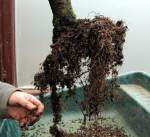
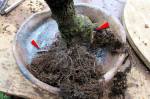
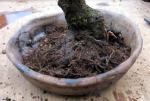
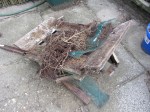
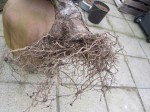
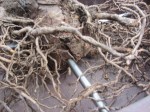
These photos are from a Prunus Spinosa (Blackthorn) after two years in the pot. My student had this tree for 12 months prior to bringing the tree to be potted in the bonsai pot. It was full of new fine roots, the student had fed the tree well and did not cut back or ‘style’ the tree in any way. The tree responded well and when potted on into a Bonsai Pot retained a lot of new root. NO wiring of the branches too place only cutting back to two buds. The tree will deliver flowers and an abundance of new growth this season. Patience always pays off when working with yamadori.

Blackthorn 2 seasons 01 Blackthorn roots 02 Blackthorn roots 03 Blackthorn roots 04 Blackthorn roots 05

Blackthorn 2 seasons 02

First Potting of the BIG Yew into a training pot + Video

Three years is a long time to find out if your collected tree has made enough root in the right place to enable you to pot the tree into a training pot. I had reached the stage where the BIG yew was ready, would there be enough root, would it fit into the BIG pot I had prepared, could I make this big heavy tree stable and secure?

My good friend David Barlow was there to help me. David is a superb engineer and this tree would require some clever sub soil engineering to make it stable.
Cutting the rootsThe tree was suspended between two plant pots so that I could work to remove the plastic pots easily. David held the tree and I set to work. I was very pleased with the amount of new root the tree had made.

When the tree was collected very little root was on the tree, careful maintenance and a strict regime of misting, feeding, placement had brought the tree on well… I was happy to start the work.
The Yew had been planted in a VERY open soil mix of Acadama, Grit and pumice and a small amount of orchid bark. This ensured good drainage and an easy media for root growth.
Once the old plastic pots had been cut away the roots could be inspected closely, I decided to cut away eight inches of root so that the tree would sit well in the pot. I was aware of the old deep root from the time that the tree was collected (photograph EVERYTHING) had I not removed this the tree would have not have looked stable in the pot.
I would have liked to have had the deadwood at the base of the tree overhanging the pot, BUT when the tree was positioned in the pot it simply did not work, it had to be removed!
The Blocks wirted in

Two hardwood blocks were employed to stabilize the tree, they were fixed in place with copper wire. The base of the tree was drilled and 4mm Copper used to tie in the tree through the holes in the base of the pot.
I used large size pure Acadama in the potting as this had proved very successful on previous potting of large Yew in my garden. Once the soil was filled to the rim of the pot the drama created by the base of the tree could be enjoyed. This was important as the visual weight of tree required a strong base to sustain the appearance of a massive tree.
The first styling of the tree with the basic branch structure put in place was in November, this potting was two months ago and the tree has responded well. I guess it will be AT LEAST ten years before this tree is ready for showing… BUT it will be worth it.

Stainless steel rods secure large Scots pine in the Duffett Pot

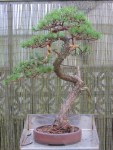
David Barlows Pine

After 10 years of establishing from the wild and two stylings David’s Scots Pine is now ready for a final potting. I found a beautiful ‘vintage’ deep red unglazed Gordon Duffett pot perfect for the tree.

Terry Foster did both stylings for the tree, the first to position the key branches, and six years later at the Burrs event in November 2012 for the second to refine.

When the tree was collected it had NO large roots. Only a few fine feeder roots, David masterfully established the tree in a very open mixture of Acadama, Alpine grit and Perlite. The tree was secured to the box with guy wires to ensure that it would not ‘rock’ and remain firm, any movement inhibit the root growth. The problem with having no LARGE roots meant that the tree could not be tied into the pot, having guy wires was out of the question so a solution was needed.

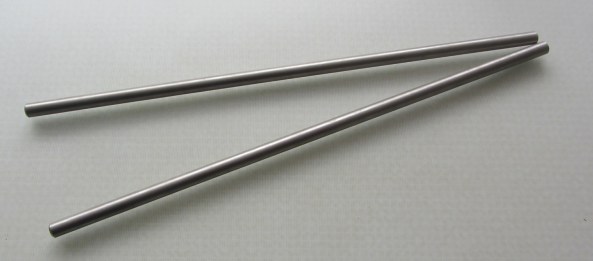
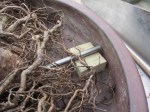
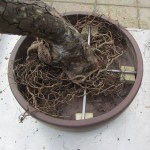
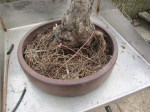
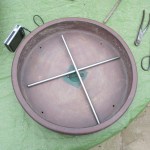
05 Stainless steel rods and PotDavid is a precision engineer with his own extensive workshop so when I requested two stainless steel rods cut to length and the ends tapered, he delivered these in less than 10 minutes. Two holes were drilled into the base of the tree under the new roots that had grown; the rods were inserted tightly into the holes in the form a ‘cross’. They were then stabilised with hardwood blocks and a layer of soil mix was added, the tree wired down onto the blocks and the whole process ensured that the tree was solid in the pot. The reason for using the wooden block was so that we could angle the position the tree exactly, each block was cut to size. More soil was added and worked into all the cavities with a chop stick.

These stainless steel rods will stay in the tree forever and become part of the root mass, they will never rust or snap. The heavy wire used to secure the tree was necessary for this final potting. After a few years when the root mass has started to solidify and the tree exhibited these wire can be cut and removed.