
 For my personal collection I have always worked on native European trees, this is for three key reasons. First: I live in the cold wet north of England and working on local material should give me the best chance to create bonsai that will thrive and survive in my climate. Second availability of good ‘imported’ material, for sure GOOD raw material worth buying was in short supply when I started in bonsai 30 years ago, simply put the trees coming out of the far east were the runts of the litter, we got the crap that that they did not want. Thankfully that appears to have changed over the last few years as the art is in decline in Japan more material is becoming available and at the right price. Third: Most material coming from the Far East is either ‘finished’ or ‘semi-finished’ I am an artist who prefers to work with totally raw material even though it takes longer, the satisfaction is greater.

This year however a Chuhin White Pine caught my eye… It displayed all the attributes and potential to create a great tree… Almost 100% of imported White Pines (WP) are grafted on Black Pine (BP) stock, this is done because BP is stronger and the bark quality is great, the problem is the graft is usually so prominent to render the tree quite ugly because the transition from Black to White is pronounced. On my tree it is almost invisible.
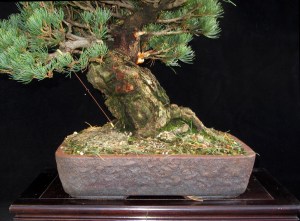
The tree was very healthy, had an abundance of foliage, good nebari, movement and taper… all things that you should look for when purchasing a bonsai, I was smitten… I bought my first ‘import’. Immediately after purchase it needed repotting as it was pot bound (this was why the price was favourable) I slip potted the tree into a lovely Dan Barton Pot.
That was six months ago, this week with the help of Mikey I completed the styling started by Hans van Meers and a few of the guys at the Burrs Event… THEY were supposed to complete the tree but never got past needle plucking and wiring a few branches… I believe beers and chatting got in the way! So it was down to me and Mikey to do the work.
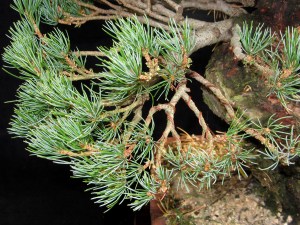
The tree had an abundance of needles that needed to be removed. After selecting those branches I no longer required we set about wiring the remainder. This took over seven hour’s work fine wiring and bud selection. WP only has one growth per year and back budding has to be carefully managed, this first styling involved branch placement and random bud removal with a view to the final image being a refined fuller canopy in a couple of years.
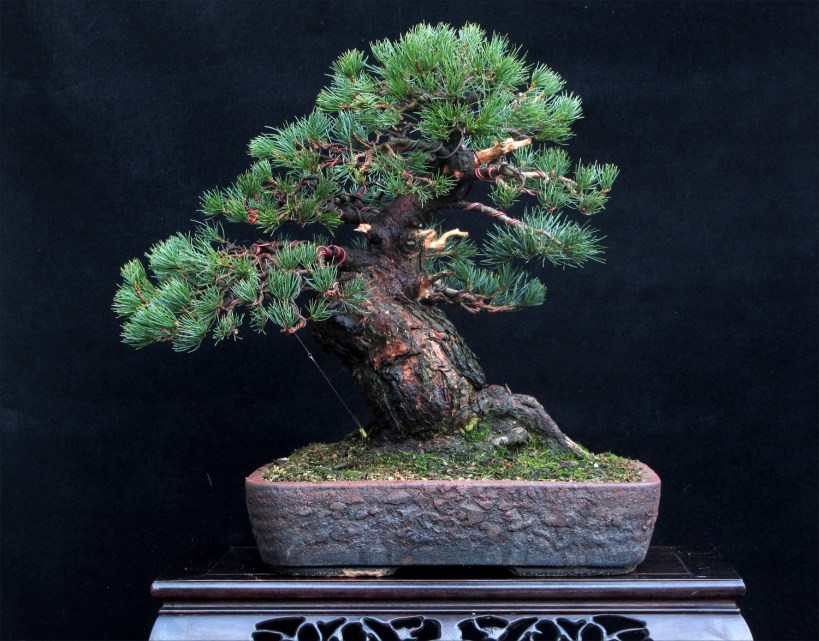
The tree finally wired for its ‘first’ styling








 Bonsai & Yamadori from Tony Tickle