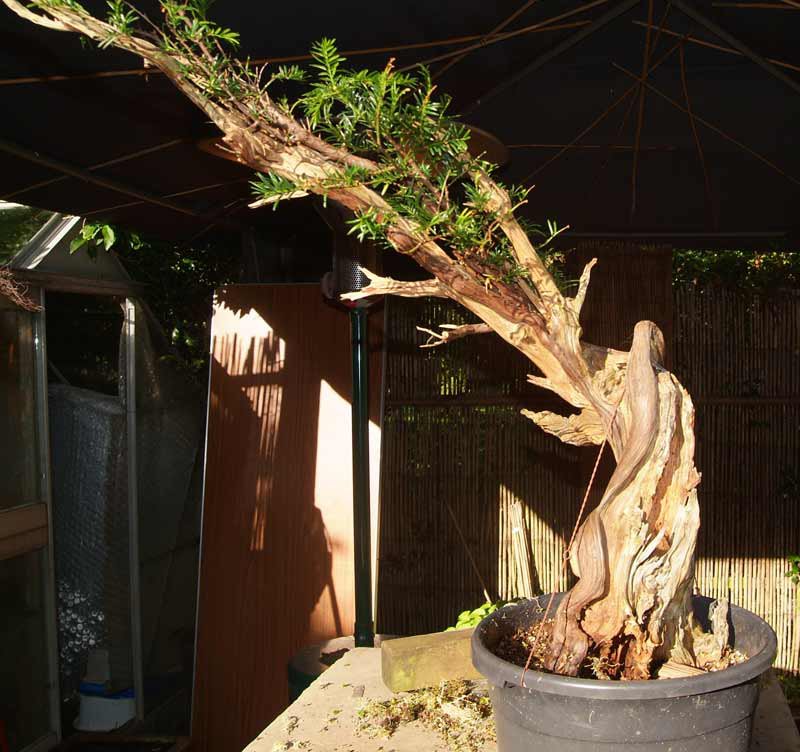
Today I did the progressive styling on the Tall Yew. The tree is now well established in the pot and has a strong root system that’s developing sturdy branches and a lot of foliage. With the help of a hot summer and careful feeding regime the tree is growing well.
The Progressive styling
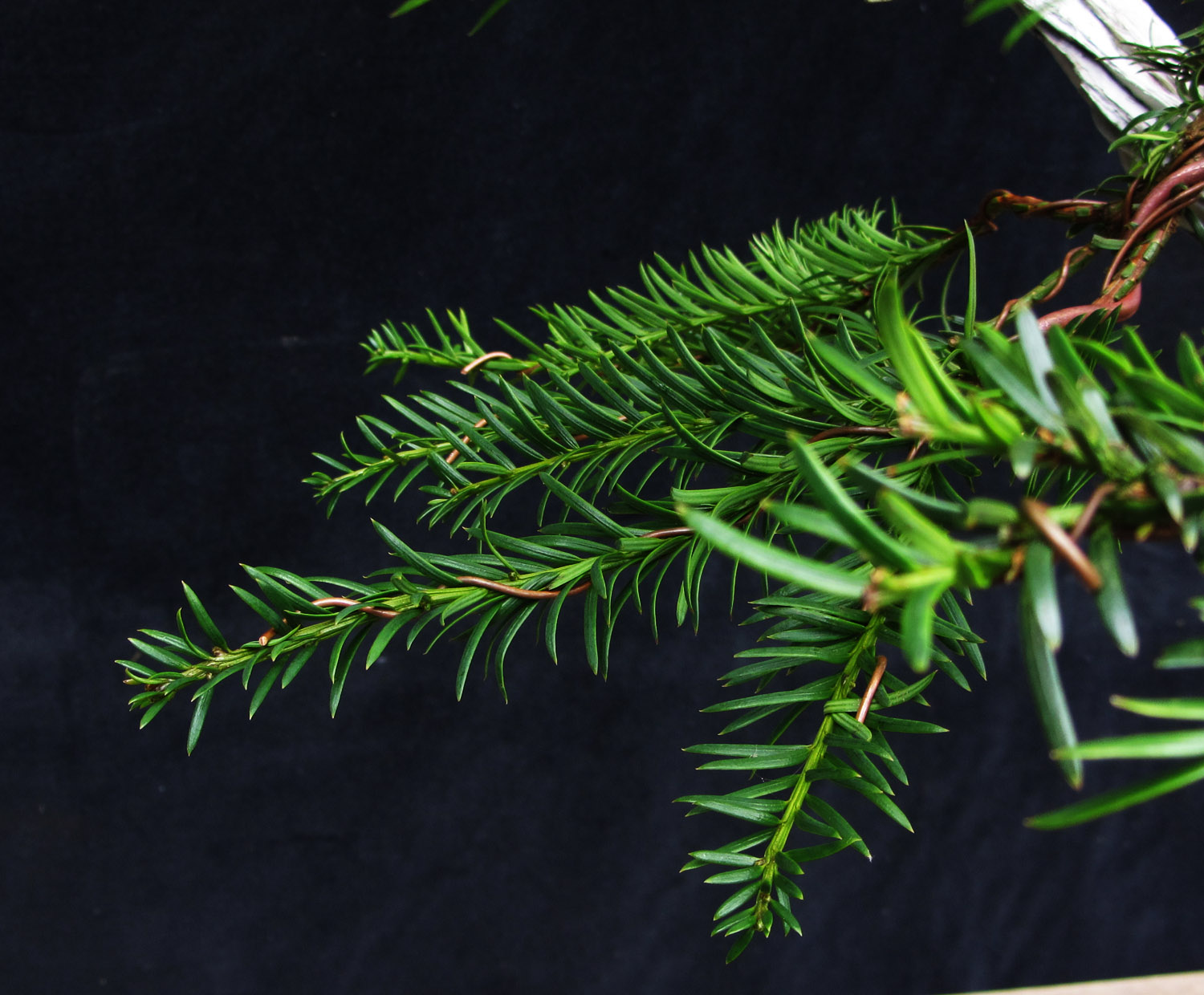
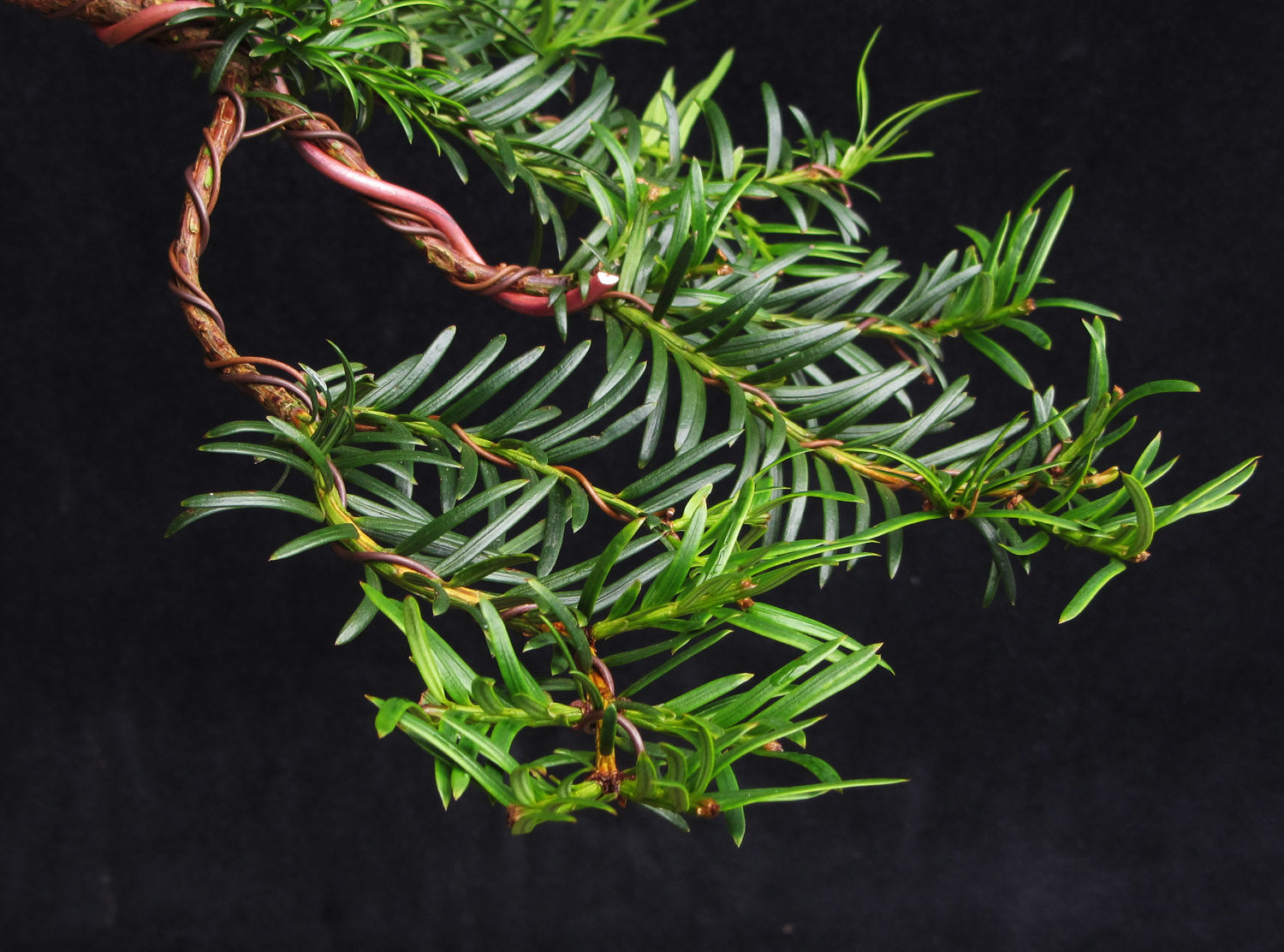
I removed about 30% of the foliage, and wired the rest. I grew a branch at the rear of the tree and replaced the previous one on the lower right because it was brought down from the crown and I was not happy with the structure. This branch now needs to thicken and ramify, the branches are left uncut to grow long, and these will be cut back at the end of the growing season. The lower left branch is well underway and has been cut back to a few needles. Where I want back budding I have removed the inner needles on three year old wood
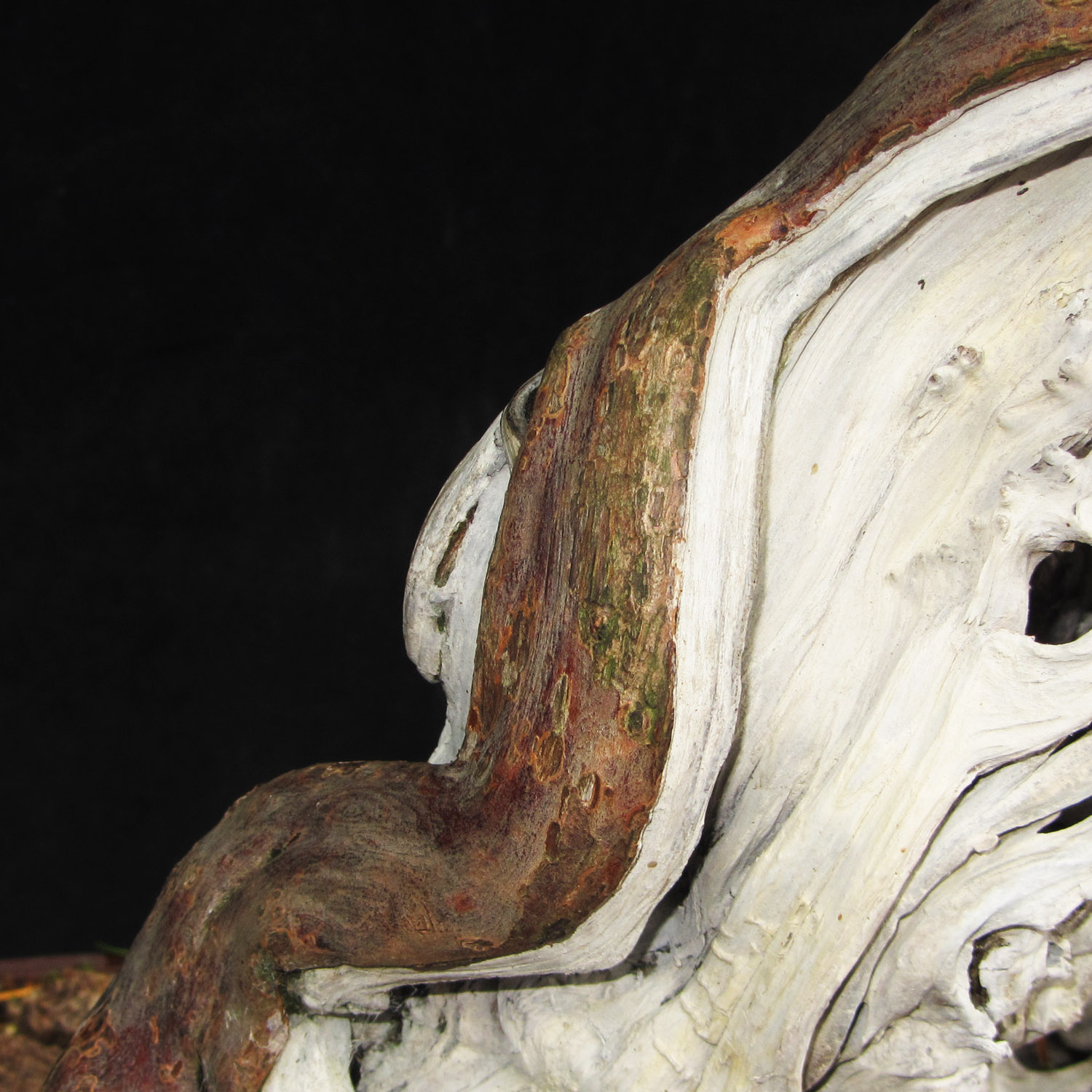
Due to the vigorous growth the wire will be removed next Autumn just prior to the branches thickening, this growth has also helped the thickening of the live vein.
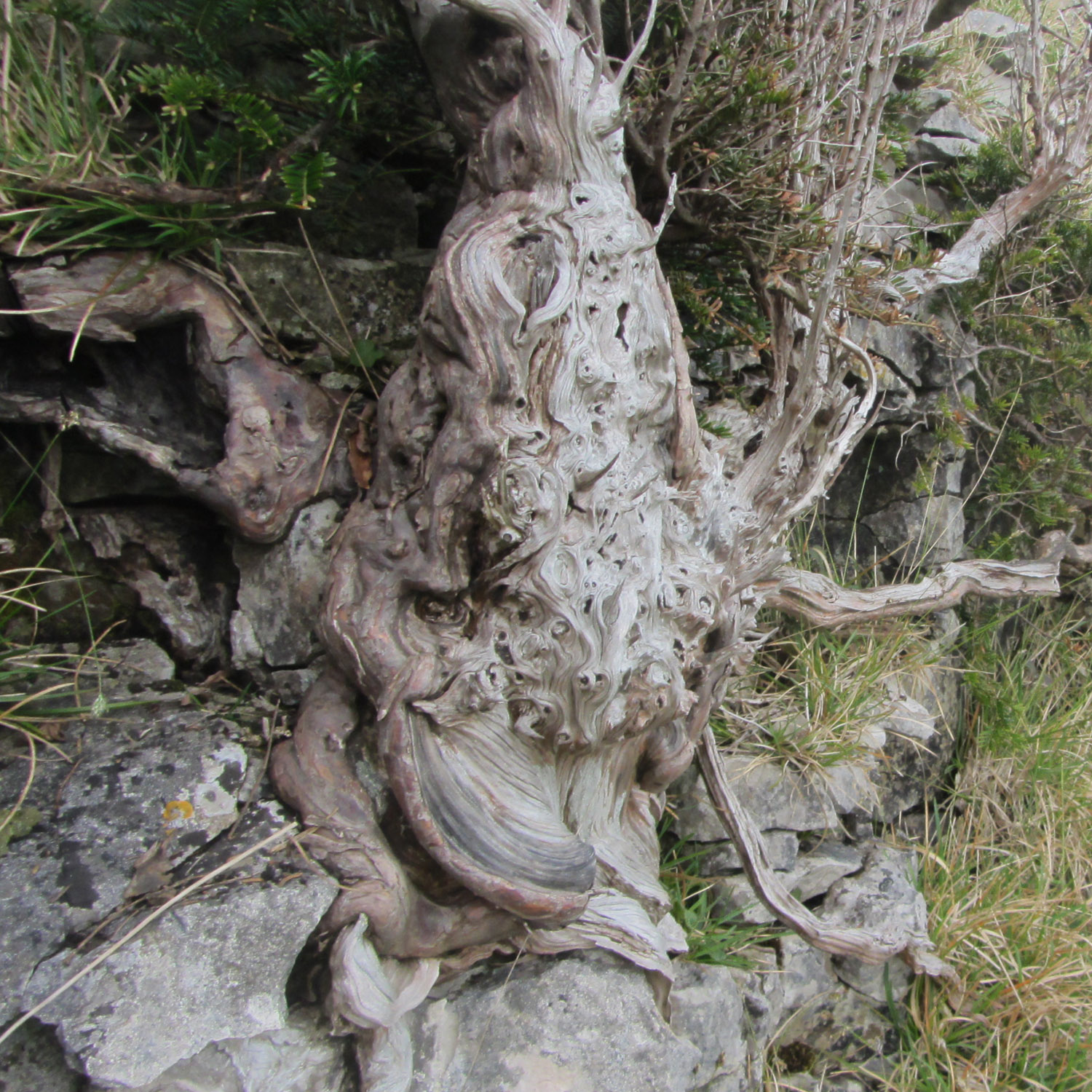
Over the last 25 years I have collected many amazing Yamadori, in all that time I have NEVER discovered a tree quite like this Taxus Bacatta that was growing half way down a limestone cliff. The amazing deadwood and twisting live vein gave the tree an incredible ancient presence.
I believe that very few people… maybe none has ever seen this tree as it’s in a VERY inhospitable, almost inaccessible location, it has survived many hundreds of years… I wanted this tree, but I also felt a deep sense of respect for this ancient survivor… so that’s where its staying.
Three years is a long time to find out if your collected tree has made enough root in the right place to enable you to pot the tree into a training pot. I had reached the stage where the BIG yew was ready, would there be enough root, would it fit into the BIG pot I had prepared, could I make this big heavy tree stable and secure?
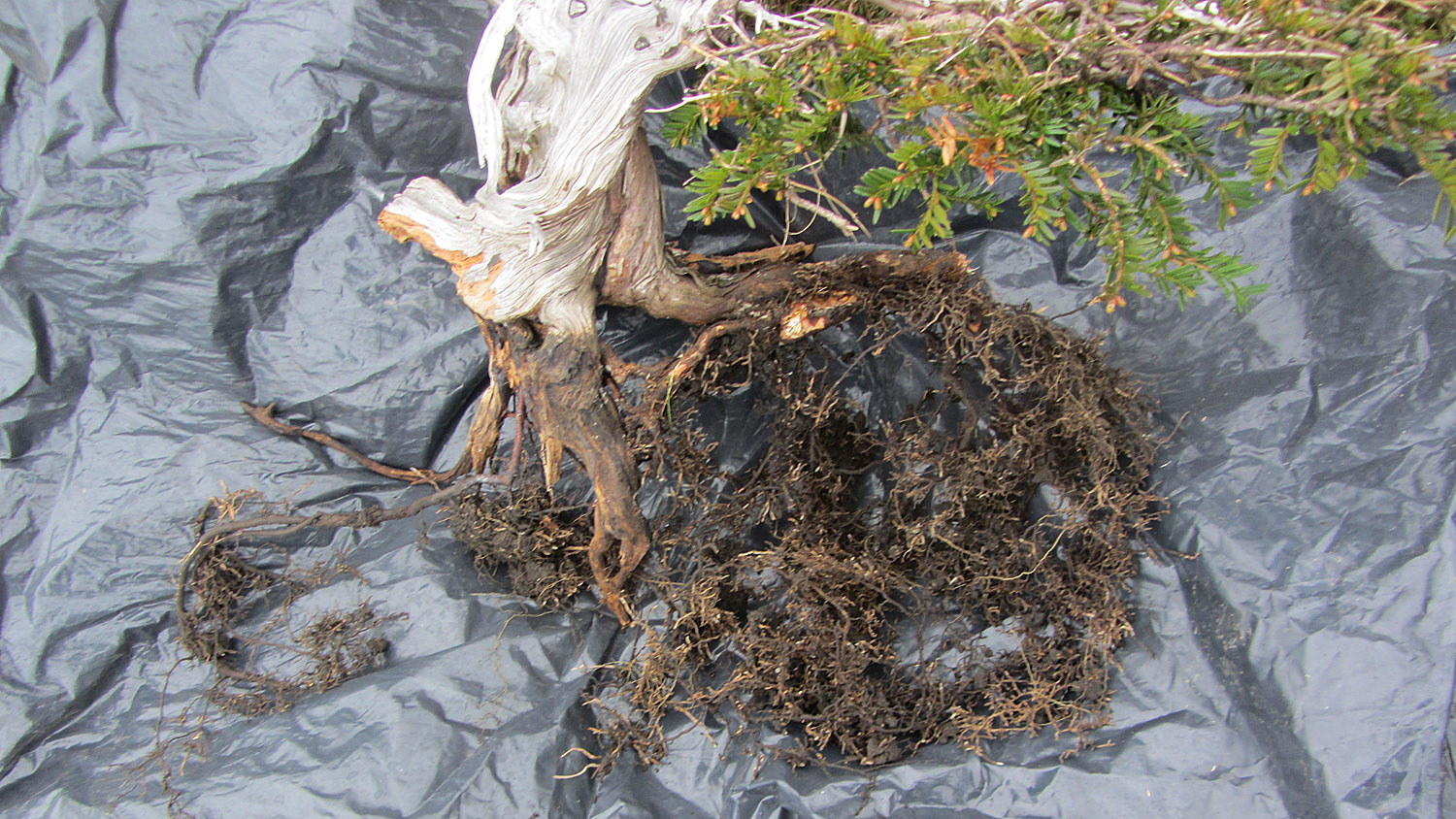
My good friend David Barlow was there to help me. David is a superb engineer and this tree would require some clever sub soil engineering to make it stable. The tree was suspended between two plant pots so that I could work to remove the plastic pots easily. David held the tree and I set to work. I was very pleased with the amount of new root the tree had made.
When the tree was collected very little root was on the tree, careful maintenance and a strict regime of misting, feeding, placement had brought the tree on well… I was happy to start the work.
The Yew had been planted in a VERY open soil mix of Acadama, Grit and pumice and a small amount of orchid bark. This ensured good drainage and an easy media for root growth.
Once the old plastic pots had been cut away the roots could be inspected closely, I decided to cut away eight inches of root so that the tree would sit well in the pot. I was aware of the old deep root from the time that the tree was collected (photograph EVERYTHING) had I not removed this the tree would have not have looked stable in the pot.
I would have liked to have had the deadwood at the base of the tree overhanging the pot, BUT when the tree was positioned in the pot it simply did not work, it had to be removed!
Two hardwood blocks were employed to stabilize the tree, they were fixed in place with copper wire. The base of the tree was drilled and 4mm Copper used to tie in the tree through the holes in the base of the pot.
I used large size pure Acadama in the potting as this had proved very successful on previous potting of large Yew in my garden. Once the soil was filled to the rim of the pot the drama created by the base of the tree could be enjoyed. This was important as the visual weight of tree required a strong base to sustain the appearance of a massive tree.
The first styling of the tree with the basic branch structure put in place was in November, this potting was two months ago and the tree has responded well. I guess it will be AT LEAST ten years before this tree is ready for showing… BUT it will be worth it.
A couple of years ago I was hanging on a rope over an 80 meter drop digging out this Year after a drive of 5 hours, a four mile walk into the hills and a very hard climb. The rain was lashing down and the dig was hard. Whilst hanging on the rope over a scary precipice, soaked to the skin and freezing cold I reflected on some recent posts on Internet bonsai forums. “Is yamadori too expensive?”.
I can only guess that those that pose this question have no idea on exactly what it takes to collect great material and make it available for others to create great bonsai. Would bonsaigirl* from Devon; make the effort to find the site, get permission, buy the gear, take a day off work, get a mate to help, get up at 5.00am drive five hours, walk in, rope up, climb down, dig for two hours suspended on a rope, carry back, pot up, establish for at least two years and have the expertise and recovery facilities to look after the tree over this period then sell for less than the cost of the fuel I somehow think not. Is yamadori too expensive? you decide.
Here are the roots after removing the rock and cleaning the duff away
Having developed my twin trunked Myrtle over the last three years and being happy that a tree from the south of Italy could indeed thrive in my garden I decided to GO LARGE and take on a rather bigger Myrtle. This was originally owned by Andrea Meriggioli and was brought over from Italy by my good friend JP to the Burrs event earlier this month, the tree caused quite a stir when brought into the workshop by two of the younger participants.
The previous owner had worked the tree for a number of years, developing branches and cleaning the trunk line of stumps. It’s up to me to bring the tree to exhibition level by further developing the canopy, working on the dead areas, repotting and refining. The current soil may well be ideal for Northern Italy but it is far from suitable for the cold wet North of England, this will be address in the spring when the tree will be repotted.
Careful consideration as to the design of the tree will happen over the winter months, it is my opinion that there are two trees within the current incarnation; I may well split the tree in two at repotting… lets see when the tree is removed!
I will shorten the long branches to two leaves, this will help me decide what will happen next. Its going to be an interesting few years but the outcome will be worth it I am sure.
This is a blog that blossomed out of a love of finding and sharing new music, and is dedicated to introducing up and coming musicians and bands from all over the world.








 Bonsai & Yamadori from Tony Tickle